14 November, 2008

Breaking News: Angelina Jolie, too busy reading 'Great Expectations', to have sex with husband


Gotcha!

There were rumours - of doubtful veracity - that Angelina Jolie used IVF treatment because she couldn't wait for Brad Pitt to do his part like a dutiful husband but I doubt that act of desperation was because she was too busy reading Great Expectations to have sex with her husband; Hard Times maybe but certainly not Great Expectations. Whether they're having sex or not is not really our business - however important that impotent knowledge may be to our meaningless existence. I've got to be honest - I don't see what is so attractive about Brad Pitt (except maybe in Meet Joe Black) but Angelina Jolie on the other hand - not the 'hottest' in Hollywood in my humble opinion but....*wolf whistle*. That's something for another post, or another blog altogether.

I know instant gratification is the norm and that you came here to read some salacious sensual account of Jolie and Pitt's sex life - which turned out to be rather anti-climactic but you're here now so you might as well stay till the end. Do you really want this to be yet another thing you never finish? I won't be long, promise.

Recently I had a copy of Great Expectations on my desk at work. A colleague remarked 'Great story' and nodded her head with such force that Mr Wemmick's 'aged parent' would be proud of. I, delighted that here was someone who had read such an amazing book and we could share our mutual admiration for it, asked her quite innocently I assure you, 'Have you read it?'. And then came the not so funny punchline - 'Oh no, but I've seen it. And loved it. Wasn't Ethan Hawke just amazing?'

And we left it at that.

If she hadn't mentioned Ethan Hawke and let me thought she meant the 1946 version rather than the buffed up modern version I might have held her in higher regards. So she hasn't got round to reading the book, I would have reasoned if I was in a good mood, but at least she's seen the movie, a true classic in its own right, but no, she'd seen the dumbed down modern version - which is tolerable at best. And I thought to myself how awful it was that people were missing out on a true gem here.

Those who know me intimately will laugh that I of all people am championing the case for Dickens. We've not always had an easy relationship to say the least. In my worst mood I'd call him a show-off (true) and a man who wrote excessively, far more than necessary - also true. Why wasn't he more busy trying to fight off the many illnesses which plagued people at the time? And he is a rather peculiar looking man with candy floss hair but let's not get personal.

However, in a good mood though I would call Dickens a prolific writer, the master of eloquence, in possession of an excellent sense of humour and a most vivid and original imagination. Believe me when I tell you, like Jane Bennet (and Darcy of course) my good opinion is rarely bestowed (like all worthless pseudo-critics). In light of that revelation my compliments may seem more complimentary.

I know his books are long. But worth the read. I know there are words you don't understand - but that means not only is it entertaining but also educational - spoken by a true geek. I don't mind people who have a read a few of his novels and not enjoyed them; you'd probably escape with a few fingers missing but we've got too many anyway. What I do mind is when people call him a bore without ever reading any of his novels. What I'd like to know is how they came to that conclusion. If you've not read anything by Dickens then Great Expectations is a fantastic place to start. I've read it so many times I've lost count. And each time I'm reading it I'm trying to work out what is it exactly that makes this book as good as it is. It's like magic. You try and try to find out how the magician did the trick but try as you might just can't.

The novel is written in first person and charts the life, the 'great expectations' of a 'nobody', of Philip Pirrip, self-named Pip. His parents died when he was an infant, as well as his five siblings - 'who gave up trying to get a living, exceedingly early in that universal struggle' - just an example of Dickens' wit. He was 'brought up by hand' by his silly cruel sister and her kind husband. One day in the marshes he meets a convict who threatens to kill him unless Pip feeds him and helps him escape. Pip, though consumed by guilt, does so but the convict is caught soon after this incident.

Pip is taken by his Uncle Pumblechook to Miss Havisham's gothic house to 'play'. Miss Havisham is a weird eccentric who stays only in the dark, wears an old wedding dress (now slghtly yellowy) and keeps all the clocks in the house stopped at the same time. She deliberately exists 'out of time' in that she has no knowledge of what month or day or time it is. There, at Satis House, he meets Estella, the adopted protege of Miss Havisham. She is beautiful, proud and cruel. Exactly what Miss Havisham teaches her to be. Later on in the novel it is revealed that Miss Havisham was jilted by her lover on her wedding day and that Estella, wanted and admired by all, is her weapon of revenge against men. Miss Havisham teaches her to be cold and distant, to flirt and trap men, like a spider (fitting then that she marries the man Mr Jaggers calls 'Spider') but never to be intimate and loving. What is remarkable is to the extent to which Miss Havisham succeeds.

Estella is cruel and merciless in her treatment of Pip. She knows he idolises her and at one point even makes him cry. Miss Havisham, pleased by her protege's progress, watches on and encourages by drawing his attention to her beauty.

Pip dreams of being a gentleman one day and being worthy of her. He is miserable with or without her, miserable of his life at home because he knows it will only repel Estella and confirm her opinion of him as common.

By a strange reversal of fortune, Pip is adopted by an anonymous gauridan and all dealings are conducted through the lawyer Mr Jaggers. He is taken to London, educated and spent upon by his anonymous guardian to make a gentleman out of him. Pip at first assumes it is Miss Havisham who is his mysterious benefactor; that she is making a gentleman out of him because she has intentions for him to be with Estella. So you can imagine the extent of his despair when he finds out that his mysterious guardian is not Miss Havisham. My lips are sealed now, anymore would give too much away and ruin the novel for you.

I think Great Expectations is one of those universally relevant novels which will always be relevant. Like Miss Havisham, it exists out of time. I think we've all felt inferior to someone we've admired at one point or another and looked for ways to be make ourselves more 'appropriate' for them. A modern example would be pretending to like something we don't in a desperate attempt to impress them. We've all felt quite content and happy with our existence until an event or a person has made us open our eyes and from that moment all that which held colour previously becomes black and white and disgusts us. Like Pip, we've all dreamt of being more than we are, of social mobility, of money and all its 'virtues'. Pip's enduring hope in the face of harsh reality is admirable and human. Even at the end - the revised ending and not the original, which I found ambiguous but more comforting than the original, Pip hopes for something ('no parting' from Estella) which is in no way confirmed. But he hopes and perhaps deceives himself - like we all do - and continues to have 'great expectations' - like we all do. I may sound sentimental but this is sentimental stuff! Note I said sentimental and not corny. A little sentiment here and there might do wonders!

And who knows, Great Expectations may do wonders for Pitt and Jolie's s life, it may not help Jolie get pregnant but three volumes in length it is guaranteed to satifsy her for longer - can Pitt make that claim? Methinks not.

In depth book review of Paul Auster's 'The Music of Chance'


The Music of Chance will always be one of the most memorable books I have ever read. Why? Because I've never found a book so disturbing (not even the likes of Ellis' American Psycho) that I had to stop reading it. I can even pin point the exact sentence I snapped shut the covers of the book and with it a most terrifying world, one that even Brave New World couldn't compare to.

But I did go back to it – noteworthy because I am rarely faithful. Like the protagonist of the novel, Jim Nashe, by the time I understood what was happening I was past the point of wanting it to end. It was only after many brave attempts and a two week lapse that I managed to muster the courage to face the ending. In that two week lapse I read - I'm ashamed to say - a romantic novel by Jude Deveraux. I loved the happy ending, the gorgeous hero and even the soft porn. Forgive me, I have sinned.

Both the elusiveness of the text and the elliptical narrative style will be familiar to fellow Auster fans. If you're looking for a compact novel with neatlty wrapped ribbons at the end, this book or anything by Auster for that matter, isn't for you. If however you're looking for a mental challenge, shivers down your spine (excuse the cliche, I doubt it will be the last) and an agonosing frustrating feeling which will trouble you even when you're trying to sleep then this novel is the book version soulmate for you.

What it all comes down to is chance and the order of events. ‘Sometimes you get lucky, sometimes you don’t’ (p2). It’s interesting that ‘chance’ means both good fortune/luck as well as its opposite - risk/hazard. If Jim Nashe hadn’t inherited by chance a substantial amount of money from his estranged father’s death then there would have been no chance of backing a poker player with a lumpy sum from the inheritance. What is at first good fortune becomes a hazard.

But if he’d only inherited that money just a month before his wife, Therese, left she wouldn’t have walked out on him; leaving him no choice but to take his daughter to his sisters. Free from responsibility he would not have quit his job, taken the wrong ramp on the motorway and therefore he would never have met Pozzi, the poker player. But even if hadn’t inherited the money at all she would never have left him if all his money wasn’t tied up in the rest home his mother had died in. And so on.

Chance meetings and occurrences, we are told, is quite common in Nashe’s life. Even his job as a fireman was the result of a chance encounter with a man he met in his job as a taxi driver. He talked Nashe into the taking the fire exam and he does so on a whim and achieves the highest grade that year. The other man was turned down but Nashe was offered a job. If we’re going to be very obvious and analytical the very essence of his job is governed by chance – you go on a job as a fireman and there is 50/50 chance you will return. It’s a risky business. Which he packs in and takes to travelling around America, just him, his car, his music and the open road and all its tantalising promises. The similarity to Keruoacs’s On the Road ends there, I promise. Actually I liked On the Road but that’s a journey for another time.


Jack Pozzi

A year and two days into this new lifestyle and with just over fourteen thousand dollars left he meets Jack Pozzi. Although generally Nashe refused to help hitchhikers (for obvious reasons) he cannot resist slowing down to observe this small, thin limping figure. It becomes apparent that Jack Pozzi isn’t drunk like Nashe first assumed but just badly beaten. ‘His clothes were torn, his face was covered with welts and bruises, and from the way he stood there as the car approached, he scarcely seemed to know where he was.’ (p19, Faber and Faber, 2006).

Despite what his instincts tell him, Nashe offers him a ride. And Pozzi accepts.

In case you’re thinking ‘this sounds familiar’ let me assure you that Pozzi does no turn out to be some psychopath who ties Nashe between two moving vehicles and rip him apart. That memorable scene is from The Hitcher – the 1986 version. Pozzie doesn’t butcher and decapitate Nashe. You’re wrong. So sit tight and read on.

Actually – talk about chance - I’ve just remembered Jim is the name of the man who offers the hitcher a ride and Nash is the pretty waitress he meets who is torn into half. Jim Nash(e). Wow. This can’t be a coincidence. Has anyone noticed this? Remember you read it here first! I think this calls for a separate post on some sort of comparison between the two. Maybe sometime next year. Sigh.

In the car, Pozzi and Nashe strike up an easy conversation. Pozzi explains that earlier in the evening he was in a poker game with lawyers and corporate hot shots. Towards the end of the game their poker game was hijacked and the thugs left with their money. Pozzi is blamed –

‘It’s just like I told you, Gil, you can’t bring riffraff into a game like this’
‘What are you talking about George?’ Gil says and George says ‘Figure it out for yourself, Gil. We play every month for seven years and nothing ever goes wrong. Then you tell me about this punk kid who’s supposed to be a good player and twist my arm to bring him up, and look what happens. I had eight thousand dollars sitting on that table and I don’t take kindly to a bunch of thugs walking off with it’ (p27)

Playing for seven years and not once anything out of the ordinary. The one time Pozzi comes along they are robbed! Is Auster making a point or what.

Pozzi informs Nashe that the day after tomorrow he has a poker game – one of the biggest games of his life. Now with no money and little potential money he’s going to have to pull out.

Now what do you think happened next? I mean here is a young man who claims to be an excellent impeccable poker player but has no money to enter the big game. Next to him you have Nashe, who has been on the road for quite a while, has quite a large lump of money left but not enough to continue funding his life on the road. Is the suspense killing you?

If it isn’t already obvious Nashe offers to help. Pozzi needs just under ten thousand pounds. Nashe tells him it’s a big risk, there is always the chance of losing to which Pozzi replies confidently ‘Sure there’s a risk. We’re talking poker here, that’s the name of the game. But there’s no way I could have lost. I’ve already played with those clowns once. It would have been a piece of cake.’ (p28).

The ‘clowns’ he refers to are two reclusive millionaires, Flower and Stone, ‘a regular comedy team’. Six or seven years ago they shared a lottery ticket and won twenty seven million dollars. Pozzi calls them Laurel and Hardy because one is fat and the other is thin. Seems fair enough to me. Nashe offers to help him out providing they split the profit 50-50. Pozzi agrees.

So ends chapter two. Chapter two I hear you exclaim. I write too much.

Nashe feels a change come over him immediately. Chapter three begins with the following words: ‘Nashe understood that he was no longer behaving like himself.’ He realizes that putting most of his money behind a foul mouthed impudent kid is risky but the risk motivates him: ‘It was a crazy scheme, perhaps, but the risk was a motivation in itself, a leap of blind faith that would prove he was finally ready for anything that might happen to him’ (p33). I love the idea of being ready for anything/something that MIGHT happen to you. Pozzi was simply a means to an end. Nashe was just going to use him and once that job was finished they would go their separate ways. What actually transpires is that Nashe becomes a fatherly figure of sort to the young man; they develop a close bond. But they do go their separate ways in the end. If you can call it that.

In New York they stay at the Plaza Hotel. Nashe pays for accommodation and food and takes Pozzi shopping for clothes.

Once Pozzi is safely tucked in bed, Nashe settles down with Rousseau’s Confessions. This is probably my favourite part of the novel. Just before he falls asleep he comes to the passage where the author is standing in a forest. He throws a stone at a tree, telling himself that if it strikes the tree his life will be better from this moment. However he misses. He moves closer to the tree and tells himself the same thing and throws the stone. Again he misses. He tells himself that was just a warm up and moves closer to the tree just to make sure he doesn’t miss. Again he reassures himself that if he strikes the tree his life will be better from that moment on. Now only a foot a away from the tree he strikes the tree. He doesn’t miss this time. Success! From this moment on life will be better, so he tells himself.

Nashe is moved and embarrassed by such naked self-deception and then falls asleep and dreams he is in the forest in which the wind sounds like shuffling cards.

By pinning his hopes on Pozzi is he deceiving himself like Rousseau? I’d say yes. Though he ‘tests’ Pozzi’s skills he is not entirely confident that they will win. He is deceiving himself and he knows it. Perhaps each stone Rousseau throws is like each hand at poker. You’ve lost this hand but never mind, you’ll win the next hand, or the next, or the next. And then everything will be fine. So you reassure yourself. I’m sure more can be said about this but I lack the eloquence.


Flower and Stone

On their way to the grand residence of the Flower and Stone they lightly banter with each other and Pozzi decides he will introduce Nashe as his brother. Some 'hireling', Murks, opens the gate and in they go.

Once inside they are taken to a ‘self consciously masculine room’ (p62) and Flower and Stone are dressed in white summer suits. The two men seem to be opposites of the same coin. Flower is talkative with a blustery humour whereas Stone is silent and observant. Stone, as his name implies has more gravitas.

Once all four mean are seated Flower tells them the story of how they struck it rich, with Stone adding a comment here and there. The turning point in the conversation comes when Flower informs Pozzi that they have been practicing everyday and night since they last played and have even taken lessons from a man called Sid Zeno – ‘one of the top half dozen players in the game’(p69) according to Pozzi.

Pozzi and Nashe are given a tour of the house and by the second room Nashe becomes annoyed by the boorish vain Flower who rarely neglects to mention what each thing cost – true to his quondam profession (accountant). They move onto the second floor and are ushered into a large room to show Stone’s creation, inside the room is a miniature model of a city with fastidious attention to detail. ‘It was a marvelous thing to behold, with its crazy spires and lifelike buildings, its narrow street and microscopic human figures, and as the four of them approached the platform, Nashe began to smile, astounded by the sheer invention and elaborateness of it all.’ (p77).

Stone called it ‘The City of the World’ and it reflects the way Stone would like the world to be, his ‘utopia’. For example, prisoners working happily at various tasks because they are glad that they are being punished for their crimes and hope to find their inner goodness again through hard work. It appears to be a pleasant enough place to live in.

Whereas Stone liked to make and create things, Flower liked to collect things. Flower’s half of the east wingo on the second floor is the exact opposite of Stone’s. Instead of one large open area he had divided the area into a network of smaller rooms. Each room is ‘choked’ with a plethora of collectable items, such as furniture, books cases, rugs, plants etc. Flower, immensely proud of his collection, fails to realise how silly it all looks, what he calls ‘gems’ and ‘treasures’ might be junk and worthless to another. It strikes me as a selfish thing to do, to consume and collect objects for a private collection (which I’m guessing he would rarely have time to admire) and thereby depriving others of a chance to see such treasured objects.

Most amazing item in his collection is a fifteenth century Irish castle destroyed by Oliver Cromwell. Yep, you read right. When there were on holiday there Stone and Flower came across the ruins of the castle, no more than a heap of stones. Flower had decided to buy it and it was shipped to America. Over ten thousand stones loaded on to a truck and then on to a ship. No wonder if cost a ‘bundle’. It now sits in their large back garden.

Nashe asks ‘you’re not planning on rebuilding the thing, are you?’ (p77). The idea seems grotesque to him. They can’t rebuild the castle because too many pieces are missing. Instead they plan to build a grand wall with the stones, ‘A Wailing Wall.’ Poor Nashe. Unbeknown to him it will be him and Pozzzi who will be building the ‘waling wall’. But more of that later.


The Poker Game

Once the ground rules of the poker game are settled the poker game begins. Nashe takes a seat behind Pozzi. The first few hands are undramatic. Flower and Stone have improved as poker players but Pozzi’s patience prevails and finally he is sitting on a large sum, twenty seven thousand dollars to be specific. As they begin to open a new deck of cards Nashe uses the interruption for a bathroom break. He feels like he can relax and let Pozzi out of his sight, the kid knows what he is doing.

He intended to go straight back to the game but instead ends up taking a stroll around the house. He spends nearly an hour looking at the ‘City of the World’. Now that he has time to take a closer look at this utopian city it takes on a sinister atmosphere. Especially the prison. ‘In one corner of the exercise yard, the inmates were talking in small groups, playing basketball, reading books; but then, with a kind of horror, he saw a blindfolded prisoner standing against the wall just behind them, about to be executed by a firing squad. […] For all the warmth and sentimentality depicted in the model, the overriding mood was one of terror’ (p87). The earlier admiration disappears and to him it appears to be a city of war, not utopia but a sort of totalitarian state.

He is just about to leave the room but then on impulse he turns around and walks back to the model. Without feeling any guilt he jerks at the miniature wooden version of Flower and Stone until it snaps and then shoves the ‘souvenirs’ into his pocket. It was the first time he had stolen anything since he was a little boy, but it was absolutely necessary and he knew that in the same way he knew his name.

Nashe returns to the poker game to find Pozzi losing. Later on Pozzi blames Nashe for his change of fortuune. His break effected Pozzi's momentum and later when Nashe shows him what he stole Pozzi becomes convinced it was that act which turned the tide for them. Logic tells us that Nashe's decision to take the miniature dolls should have no effect on Pozzi's game. The two are not connected in anyway. Clearly Auster is showing how people connect and make meaning out a seemingly meaningless act or event, exactly what Auster is guilty of in this novel.

Pretty soon Pozzi loses all his chips and Nashe sells his car to the millionaires for five thousand chips. However the ‘emergency transfusion’ doesn’t work and Pozzi loses that too. Now they have nothing, not even a car to get out of there. They strike a deal – despite Flower’s warning not to make things worse – that if they win the next hand they win the car back, if however they lose Nashe and Pozzi then owe the millionaires ten thousand pounds. A sum that matches the number of stones to the Irish castle which seems to foreshadow what will happen next.

Pozzi loses that final hand.

Nashe and Pozzi must now come up with a plan to clear their debt. Stone makes them an offer – that they build the ‘wailing wall’ mentioned earlier, ‘honest work for an honest wage’ (p97). I thought it was quite fitting that it is Stone, the maker of the city who should propose this idea. The whole idea of working for your freedom stinks of the Nazis and the Third Regime – arbeit macht frei, just the sort of totalitarian doctrine Stone would approve of.

Though outraged at first they accept and a contract is drawn up. In the meadow they have a fully equipped mobile home, work clothes would be provided as well basic essentials such as food and if there was anything else they desired all they had to do was ask. At ten dollars each for an hour’s labour they would earn twenty dollars an hour. If they worked ten hours a day that would come to two hundred dollars a day. It would then take them fifty days to make up the ten thousand dollars. Nashe offers a way out for Pozzi, that he would be happy to do the work alone but Pozzi won’t hear of it. The contract is drawn up and all four sign it. The maid makes them a meal, whereas before she was pleasant and welcoming this time she is rude and even aggressive. Nashe realises that whereas before they were guests they were now reduced to hired hands, not worthy of the maid's respect and endeavour
.


The Wailing Wall

And so the labour begins. The hireling, Murks, who had opened the gate earlier supervises over them. Murks assists with the move to the mobile home and they make a list of essentials, food, newspapers, cards etc. With no phone in the house and no view of the Flower and Stone residence they really are cut off from the world. Anything could happen and no one would be any wiser.

The slow labour begins. And by slow I mean excruciatingly slow. First the foundation must be laid, then one stone at a time and on top of each other to build the height. And it was monotonous. Their task parallels the task of Sisyphus. Though the stones do not roll back a sloped hill, it is essentially the same task over and over again. It is absurd. Perhaps it typifies the absurdity of the human condition far more than Sisyphus' example does because unlike Sisyphus, Pozzi and Nashe are sentenced to this punishment out of chance, they are sentences to this punishment because of something out of their control. Chance events brought each of them on that road for the fulfillment of a chance encounter, followed by defeat in a game governed by chance. Like human life, events which appear out of their control make them bear the consequences. All is not well.

The wall is menacing and all that it connotes, a barrier, a restriction. The closer the become to finishing their ‘time’ and therefore to escaping the more they close themselves in. It is slightly poignant that they are building the very wall which prevents their escape, like when victims are forced to dig their own graves. I can’t even begin to imagine what that would feel like.

Things become slightly sinister when Murks starts wearing a gun after a brawl with Pozzi. Now they are in ‘real’ danger. Whereas before the danger was never visible, never real but just a feeling they had, an atmosphere created, it is now very real in the shape of a gun.

The end of fifty days arrives but Pozzi and Nashe decide to stay on a bit longer to make a little money for themselves. They decide to have a celebration on the night they would have left and no expense is spared – caviar, lobster, cake, champagne and a prostitute for Pozzi. Murks informs Nashe that though Flower and Stone didn’t approve they accepted and would get them everything they needed for the party. Nashe’s instincts tell him that Flower and Stone are not the sort of people who splashed out for other people’s party and it puts him on his guard.

The party is eventful, to say the least, for Pozzi.

After a small period, in which they accumulate money for themselves, their ‘release’ day arrives. Pozzi is excited beyond words. Nashe, on the other hand, just felt empty and numb. Murks arrives with a single sheet of typed paper.

On reading the contents of the paper and realising in less than a second what it meant I closed the book very slowly and left it on my desktop out of sight for a period of two weeks.

What was on the paper?

I’ve not mustered the courage to talk about it yet so you will just have to read it for yourself.

10 November, 2008

Random

The Nation's favourite 'concave' crisp is not actually 'concave' as Paul Merton once assumed on Have I got News for You. Nope, it's 'hyperbolic paraboloid'. What am I doing?? I feel a rant coming on, early mid-life crisis. Quick, sign off.....

05 November, 2008

YES WE CAN - History in the making


A friend of mine was up all yesterday night to see the outcome of the United States presidential election 2008. She text me in the early hours with the results. Thanks Rookie. Barack Obama is the new president of America. A small step for him, a giant leap for the rest of us. And ever since I've had this of feeling of elation and of hope. I feel like anything is possible. To walk around in ignorance and pretend that what happens on the other side of the world doesn't affect us is not only wrong morally but just plain stupid. With impending problems such as global warming, global financial crisis and even the possibility of world wars I think it's high time we all came out of our insulated cardboard boxes. You should know by now a butterfly flaps its wings in some remote forest and the repercussions can be felt on your cardboard box.

I've seen and read his acceptance speech in full, which can be found here http://www.guardian.co.uk/commentisfree/2008/nov/05/uselections2008-barackobama.


Needless to say it 'moved' me. Me who is far too young to be this cynical; me who never thought it possible that America would vote for a Black president; me who is cautious of people who talk as nicely as Barack Obama does.

There's lots I don't understand or know about. I'm not familiar with all his policies. I'm not sure what his future plans are and if there will be a disparity between his plans and reality. I don't know if his plans for American will impact us here in Britain or even the rest of the world. I don't know if I will still be rooting for him at the end of his first term.

What I do know exactly this minute on 5th November 2008 at 1.10 p.m and what I've written in bold on my facebook profile is that whatever the outcome in the future I'm glad I've seen history made, I'm glad America has risen above all its prejudice and I'm glad we have someone in Obama who is not willing to follow Bush-policies. Whatever he does or doesn't do, it can't be as bad as the last eight years. And yes, I've read Chekhov's Champagne so I can say it with confidence.

I am slightly worried that I've never been this excited about any British elections. I've never been 'moved' by any speech by a British politician. But British elections lack the charm, the wit, and the endearment that American elections possess. I've never felt empowered by British politicians. Perhaps our stiff upper lip needs to be slightly more limb and our British wit slightly more foreign.

In short, we need to be a bit more like Obama. Better dressed and groomed; more eloquent and charming; more honest and caring with a final sprinkle of charisma.

In Obama I find a rare honesty in his appearance and speech that has been missing in politicians for as long as I can remember. In Obama I see he is not only thinking about the life expectancy of his cardboard box. In Obama I see that he cares, genuinely and passionately, and that he won't sit in the white house and make decisions with an olympian detachment, decisions which affect not just people of America but people throughout the world. In Obama I see a change for the better. Or perhaps I am fooling myself and hoping too much. After all, when you take those pretty snow globes by the hand and you give it a good mighty shake the snow flakes still fall back in the same place as before, more or less.

I just hope he doesn't crack under the pressure or fail to live up to all our high expectations.

Barack Obama, can we fix it? YES WE CAN.

03 November, 2008

The Danger of F7

This poem, by Dean Hunt, made my day - it's about relying on the spell'chequer' too much and not using the good old fashioned dictionary:


Eye halve a spelling chequer

It came with my pea sea

It plainly marques four my revue

Miss steaks eye kin knot sea.


Eye strike a key and type a word

And weight four it two say

Weather eye am wrong oar write

It shows me strait a weigh.


As soon as a mist ache is maid

It nose bee fore two long

And eye can put the error rite

Its rarely ever wrong.


Eye have run this poem threw it

I am shore your pleased two no

Its letter perfect in it’s weigh

My chequer tolled me sew.


(http://deanhunt.com/mi-speal-chequer-doos-nut-werk/)

24 October, 2008

Noboby leave the room, everyone listen to me, we had ten tampons at half past two, and now there's only three...

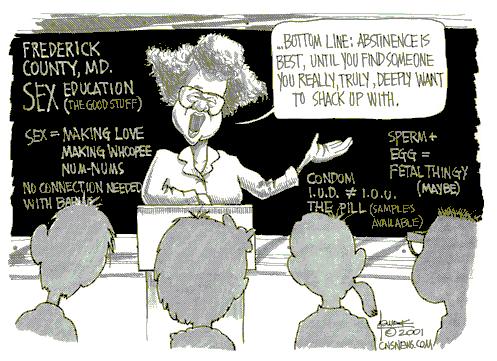
Prepare yourself for a new generation of perverts, drug abusers, teenage pregnancy, STD carriers and nymphomaniacs. Slightly hyperbolic I know but desperate measures calls for desperate rhetoric. What am I on about? I'm on about the government's ingenious idea of planning to make sex education compulsory in primary schools.


Yesterday's Guardian article quoted a spokesperson for Life Education: 'If we want to make a real and lasting difference to teenage drug and alcohol misuse, we must reach them early - at primary school'. Evidently the government has not had time to review the adverse effects of sex education in secondary schools. Minette Marrin in a recent Times online article points out:


[...] sex education has been an utter failure. The increase in sex education here in recent years has coincided with an explosion of unwanted pregnancies and sexually transmitted disease (STD) far worse than anywhere else in Europe. Since the government’s teenage pregnancy strategy was introduced in 1999, the number of girls having abortions has soared. You might well be tempted to argue that sex education causes sexual delinquency.


It begs the question then that faced with such startling statistics why the government want to make sex education compulsory amongst children who still believe in mythical figures like the tooth fairy and Santa Clause.


My generation will be familiar with the science modules on human biology and how babies are made. I remember boys throwing about tampons and menstrual pads - shouting 'Here have a pillow' and sniggering. I'm not saying primary school kids will do this but something similar and more childish. Hitting each other with pads and using tampons as weapons - the latest James Bond gadget, may just be the norm. At the end of the school day teachers won't be asking where have all the scissors gone - but - nobody leave the room, everyone listen to me, we had ten tampons at half past two, and now there's only three. And so the search will begin. One tampon may be amongst the crayons, pretending to be a white crayon; remains may be found of one in the pet cage - what the hamster couldn't swallow and one in the teachers' tea - for scientific purpose of course, to see how much it can absorb.


Concern has been expressed by the sane about sexualising children by teaching them sex education but how do you desexualise sex? Perhaps we will be rigorously scientific and use scientific terms. A child who struggles with remembering and spelling difficult words is expected to take on board terms like vagina, placenta, fallopian tube, uterus, scrotum, prostate gland - need I go on? Maybe to help them learn we can have song-like-poems, like in Matilda - you know - Mrs D, Mrs I, Mrs F F I, Mrs C, Mrs U, Mrs L, T Y - spells difficulty. Mr T, Mr E, Mr S T, Mr I, Mr C, Mr L, Mr Eugh - spells trouble.


I'm over reacting as usual. We're going to teach them BASIC sex education. What is 'basic' sex education? Where do we draw the line? You don't think curiosity will get the better of them? That you can tell a ten year old that a sperm penetrates an egg in the ampulla of the fallopian tube and he or she will simply note it down and that would be all? That's 'basic'. What about all the follow up questions? Teaching little kids is difficult enough without having to teach them about sex.


The problem with a 'basic' and scientific description of sex and how babies are made is that it is bereft of all human emotion. Isn't that the very problem we are trying to overcome? That sex isn't treated as a wonderful way to express human emotion but a competition, a league table of how many you've scored.

And no one is thinking about the teachers! What about the teachers? Teaching a classroom of ten year olds the basics of sex could have a detrimental effect on their sex life! Little money, no peace, and now no sex. There goes a generation of potential teachers. Think of the hot flushes in the classroom. The staff room gossip - 'My year 4s asked me to demonstrate penetration'. And I guarantee you one cheeky ten year old will ask 'Sir, do you have sex? How often?'

Maybe it's me. Maybe I'm not modern enough, maybe I'm too old-fashioned, maybe I need to get with the times, maybe I'm prude or worse yet naive. But every fiber of my being and the little logic I possess vehemently and passionately tells me that teaching sex education at primary schools is wrong, wrong, wrong. Wrong morally, wrong ethically, wrong politically. Period. Oh and good luck explaining that to a ten year old boy!

23 October, 2008

Willaim Hazlitt - the first modern man?

Below is a Sunday Times Review by John Carey on Duncan Wu's 'vigorous' biography of William Hazlitt- a biography of doubtful veracity it seems. The article doesn't really review the book but offers interesting details about the life of Hazlitt, a great over view for those, like myself, who know very little about - perhaps - the severest critic of the Romantic period.

It can be found here:
http://entertainment.timesonline.co.uk/tol/arts_and_entertainment/books/non-fiction/article4954754.ece


William Hazlitt: The First Modern Man by Duncan Wu

The Sunday Times review by John Carey

William Hazlitt's collected writings fill 22 volumes. He was a literary critic, an art critic, a theatre critic, a philosopher and a polemicist, and his works The Plain Speaker (a collection of essays) and The Spirit of the Age (a survey of the writers of the Romantic period, most of them known to him personally) used to be revered as classics. Nowadays he is scarcely known, and Duncan Wu's vigorous biography, the fruit of 10 years' labour in the archives, is an attempt to put that right. The Hazlitt he brings to light, however, is unlikely to win a place in his readers' affections. He was a tormented, bitter man, who excelled at resentment.

His father, an Irish dissenting minister of heretical views, had taught him to hate all institutions, whether of church or state, and since human society is based on institutions this was an important first step towards his son's unhappiness. Born in 1778, young Hazlitt greeted the French revolution with frenzied enthusiasm. He idolised Napoleon, and was filled with hope that the victorious French would put an end to Britain and its constitution, an event that, Wu tells us, both Hazlitt and his father had long wished for.

The defeat of his hero at Waterloo was a devastating blow. He did not wash or shave for weeks and got drunk every night. As a teenager he had much admired Wordsworth, Coleridge and Southey, and sought their friendship, joyful that they shared his revolutionary ardour. However, the reign of terror, followed by the imminent threat of a French invasion, drastically modified the three poets' political views. They supported the British government's repressive measures against suspected revolutionaries, and Wordsworth even enlisted in the Grasmere volunteers, a unit that was fortunately not cast in a combat role.

Hazlitt never forgave them. He denounced them as turncoats and pursued them with derision and vituperation. Reviewing Coleridge's poems in 1816 he dismissed Kubla Khan as “nonsense verses” and Christabel as “utterly destitute of value”. Wu says that he knew perfectly well they were works of genius, but lied about them to get his own back on Coleridge - behaviour that Wu is inclined to condone. It seems questionable, though, whether changing one's political allegiance is necessarily as heinous as Wu seems to feel. In the last resort, the poets' sin was merely that they were less keen to see the end of Britain and its constitution than Hazlitt was.


However, Hazlitt's rancour was implacable, and its source was not only political. In 1803 a strange episode took place that permanently poisoned relations between him and his former friends. He was staying in Coleridge's house at Keswick, and went out one evening to the local tavern, where a girl he tried to chat up made an impudent remark. His response was, Wu says, “characteristic”: “He threw her over his knee, lifted her petticoats, and spanked her on the bottom.” He then fled to Coleridge's house, where news arrived that a gang of locals was on its way to wreak vengeance. Coleridge and Southey rapidly smuggled him out of Keswick to Dove Cottage, where Wordsworth took him in, supplying him next morning with money and clothes so that he could get away.

Since the three poets quite possibly saved his life, it might be expected that he would repay them with thanks. On the contrary, he began to feel that he had been unnecessarily humiliated, and came to see himself as the victim, and his rescuers as malicious persecutors. As usual, Wu takes his side. “Hazlitt was not an embittered or grudgeful man,” he maintains, “but the treatment he suffered at the hands of Wordsworth and Coleridge was to rankle for the rest of his life.” Hazlitt's extraordinary capacity for feeling hard done-by was also apparent in the matter of his first marriage. His wife was the sister of a successful barrister, John Stoddart, and since Hazlitt was a penniless journalist, and often in debt, Stoddart generously set up a trust to make the newlyweds an annual allowance. Far from being grateful, Hazlitt saw this as a “mammoth humiliation”. It “filled him with disgust for years to come”, Wu testifies, and was one of the “corrosive forces” that destroyed the marriage. Hazlitt repaid his benefactor by describing him, in a newspaper article, as a “stupid, senseless, vulgar person”, and likened The Times, of which Stoddart was editor, to a “water closet”.

Another corrosive force that destabilised the marriage was Hazlitt's fondness for the company of prostitutes. He gave them free run of his lodgings, which inevitably fuelled scandal and also distressed his young son, who was so appalled on one occasion by the noises coming from his father's bedroom that he intervened physically. Pathologically shy and tongue-tied in company, Hazlitt seems to have found sexual satisfaction only with women he felt superior to socially. He fell madly in love with his landlady's daughter, Sarah Walker, who was, apparently, willing to engage in lengthy petting sessions, but refused to have sex. He persuaded his wife to divorce him, in the hope that this would win Sarah over, but she still resisted, and he vented his thwarted lust and rage in a detailed account of the affair published in 1823 as Liber Amoris, which mingles feelings of contempt based on social class with sexual loathing and hysterical denunciation. He describes himself as “glued to a bitch, a little damned incubus”, and Sarah as “a common lodging-house drab” with “an itch for being slabbered and felt”. Wu endorses Hazlitt's judgments. Sarah was, he assures us, “exactly what he feared: a snake, a succubus”, and feminist critics show their “stupidity” by accusing Hazlitt of sexual harassment. All the same, they seem to have a point. When Sarah finally rejected him he persuaded a friend to move into the Walkers' lodging house with the express intention of seducing her. The friend reported back to Hazlitt, who noted his accomplice's progress in a diary. He appeared naked before Sarah, and kissed her on several occasions, but apparently got no further.

Publishing Liber Amoris was an act of self-destruction. The Tory press seized on it with delight, execrating its author as a libertine and whoremaster, and Hazlitt's reputation was in ruins. He died in poverty. Wu's biography is, like its subject, passionately partisan, and throws objectivity to the winds. He gleefully applauds Hazlitt's “rabble-rousing” tirades, and lambasts his enemies as blackguards and liars. At times he verges on fiction by inventing conversations that he feels must have taken place, but which do not occur in the historical record. This may attract scholarly frowns, but it undoubtedly livens up his writing.

For all that, the claims he makes are wildly extravagant. The reader blinks to learn that Hazlitt possessed “laser-like intelligence” and “an almost godlike perspective”. Such estimates cut no ice unless backed by the kind of analysis that Tom Paulin attempted in The Day-Star of Liberty, and Wu never gets near that critical terrain. The samples of Hazlitt's essays, art criticism and lectures that he offers seem verbose, far from incisive, and not always notable for intelligence. What sort of intelligence concludes (in Characteristics) that “Women have as little imagination as they have reason; they are pure egoists”? Nor is it clear why Wu considers Hazlitt the first modern man. All it seems to amount to is that Hazlitt was a journalist, so foreshadowed the power of the mass media. But, to qualify as modern men, competitors must have had ideas we still use in our thinking. Among Hazlitt's predecessors Montaigne, Newton and Rousseau all did that. Among his contemporaries, Wordsworth and the protosocialist Robert Owen, whom he dismissed as insignificant, did so, too. Hazlitt did not.

17 October, 2008

Next on the never-ending reading list....

(In no particular order of course)

Little Dorrit by Charles Dickens

Les Miserables by Victor Hugo

The Secret Scripture by Sebastian Barry

The Kite Runner by Khaled Hosseini

Experience by Martin Amis

Perfume by Patrick Suskind